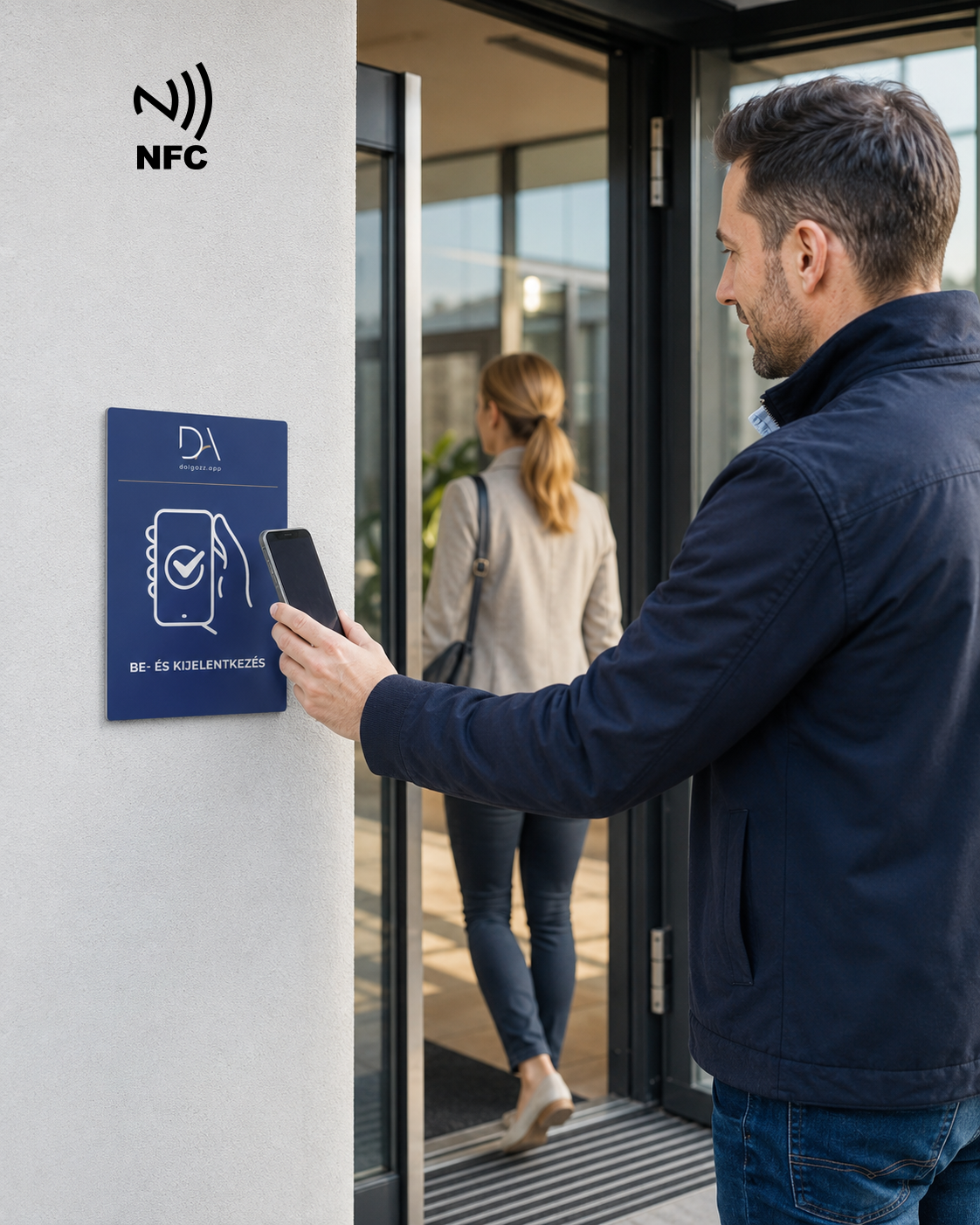
How NFC check-in works in the field and why it's faster than paper or GPS-only solutions.
The NFC board serves as a fixed check-in point: the employee taps their phone, and attendance is instantly recorded. No need for GPS, no shared computer at the gate. One tap, done. The shift starts where the work is.
In practice, this means fewer disputes and faster monthly closures. Managers can see who arrived when, and employees are done in seconds. No queues, no notebooks, no "I'll write it down later."
Why GPS Isn't Enough
It works well outdoors. In factories, underground car parks, kitchens, and office buildings, it often doesn't. The signal lags, entry happens in the parking lot, and disputes arise at closing. The employee claims they were inside. The system shows otherwise.
NFC is independent of this. The board is at the entrance, in the locker room, or on the work floor. Whoever taps it was there. Not nearby. There.
What Does a Check-In Look Like?
The board is up. The app is on the phone. Tap. Check-in. The same for check-out. No separate entry terminal, no continuous location tracking required. Attendance is tied to the point, not the phone's movements.
The board can also feature branding: company logo, site name. Employees see where to tap. Managers see which point the data came from.
When Is It Worth It?
- Indoor locations where GPS is inaccurate
- Multi-site operations
- If personal phones aren't mandatory, but touch-based entry is
Especially clear with multiple sites: each location has its own point. No confusion over which store or site someone started at. Monthly closures consist of taps, not explanations.
It works without personal phones if entry is via a shared device with a PIN. NFC then acts as the site's stamp: this is the shop, this is the warehouse, this is the gate. No need to force GPS.
Fewer Disputes, Not More Control
NFC isn't about tracking employees. It's about quick entry and data that holds up later. Employees are done in 10 seconds. Managers aren't guessing. Compared to this, paper and GPS-only are slow or disputable.
If attendance is tied to the location, disputes decrease. Closures speed up. The queue at the gate disappears.