The decision is made.
The company is finally digitalising.
We select a new system, review the features, compare prices, and proceed with implementation.
The management is enthusiastic.
Then a few weeks pass.
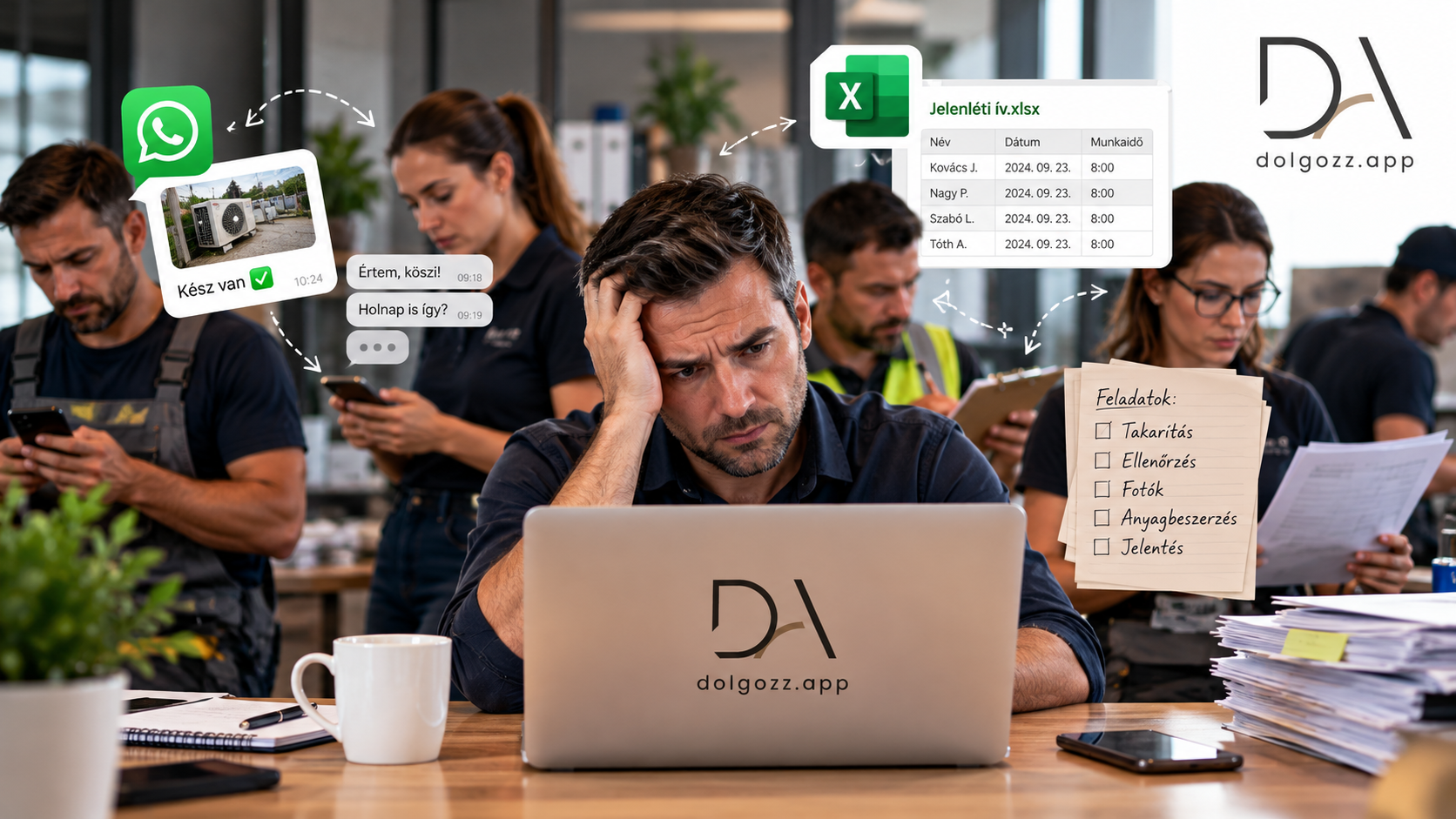
One colleague continues to use Excel. Another sends photos via Messenger. Someone else writes down work hours on paper. And another simply doesn't log into the system.
Eventually, the familiar phrase emerges:
“The employees don't want to use it.”
But is it really the employees who are the problem?
The Manager Chooses the Software. The Employee Gets Extra Tasks.
This is one of the biggest differences when implementing a corporate system.
The manager sees:
transparency, reports, automation, control, less administration.
However, the employee often sees something entirely different:
another application, another password, another place to enter data.
If a task previously required two steps and now requires seven in the new system, it's hard to explain that this is digitalisation.
No matter how advanced the software is.
If it complicates the user's life, there will be resistance.
Most People Don't Want to Learn Software
And perhaps they shouldn't have to.
A cleaner doesn't come to work to learn a corporate management system.
A technician doesn't go on-site to fill out twenty fields.
A security guard shouldn't start their shift with an 80-page manual.
From their perspective, the software is not a goal.
It's a tool.
Therefore, ideally, using a good system shouldn't require being an IT expert.
I've arrived.
I start the work.
I see my task.
I complete it.
If needed, I take a photo.
I finish.
That's it.
The system should handle the complexity, not the person.
Too Many Features Can Sometimes Be a Disadvantage
It's easy to fall into a trap when choosing software.
One system offers 80 features.
Another offers 120.
The third offers 250.
On paper, the third seems the best.
However, the business might only need fifteen of these.
The remaining 235 features may not necessarily add value.
They could be 235 opportunities for the user not to find what they're looking for.
The best corporate software isn't the one with the most features.
It's the one that allows the necessary work to be done as simply as possible.
The First Days Can Decide Everything
There's another common mistake.
We buy the system, create the users, send out login details, and say:
“From Monday, we'll use this.”
Technically, this can be an implementation.
Humanly, not necessarily.
The user needs to understand what changes, why it changes, and most importantly:
how it will make their life easier.
There's no need for hours of training.
Often, quite the opposite.
On the first day, only show what's needed for that day.
If someone only needs to start and stop attendance, let them learn that.
If someone needs to manage tasks, let them start with that.
The rest can come later.
Digitalisation Isn't Successful Just Because We Bought the Software
It's successful because it's used.
This may seem like a simple statement, but it makes a huge difference.
A fantastic system, where the company uses 20% of its features, can easily create less value than a simpler solution that truly integrates into daily operations.
Therefore, before implementation, it's worth asking not only:
“What can the system do?”
But also:
“Will our people actually use this?”
This Is Why We Think Differently at Dolgozz App
At Dolgozz App, it's a constant challenge to add more features to the system.
Attendance. Schedules. Leave. Tasks. Projects. Workflows. Documentation. Checkpoints. Reports.
Technically, it would be easy to present everything to the user at once.
But that's not the goal.
The goal is for an employee to see what they need, and for the manager to get the information required to run the company.
And the implementation is equally important.
It's not just about providing access to a new system.
It's about helping it become part of daily operations.
Because the value of corporate software is ultimately not shown by how many features are listed on its website.
But by a much simpler thing:
do people use it on Monday morning.